This article contains affiliate links. If you book through them, I earn a small commission at no extra cost to you.
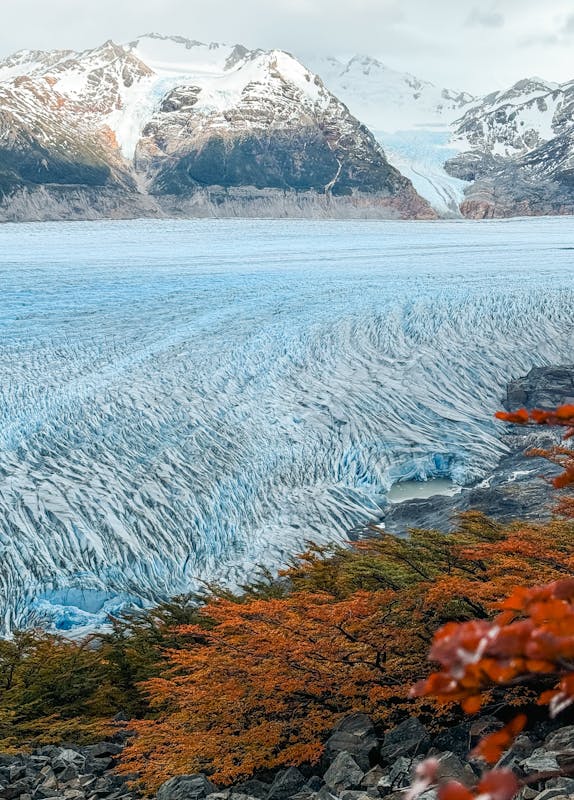
I was expecting white. Every glacier photo I had ever seen was white — white ice against grey rock, maybe a hint of pale blue. So when I came around the last bend in the trail and Grey Glacier filled the view ahead, the color stopped me mid-step. That ice was blue. Not slightly blue. Not blue-ish. A deep, saturated, almost electric blue that looked like someone had Photoshopped a stock photo and cranked the saturation slider. Except nobody had. That was just the glacier, doing what 5,000-year-old compressed ice does when sunlight hits it at the right angle.
I stood there for longer than I should have, given that I still had three hours of walking ahead. But that first view of Grey Glacier from the trail above Lago Grey is one of those moments that earns the whole trip to Torres del Paine.
Getting There: The Catamaran Across Lago Pehoe
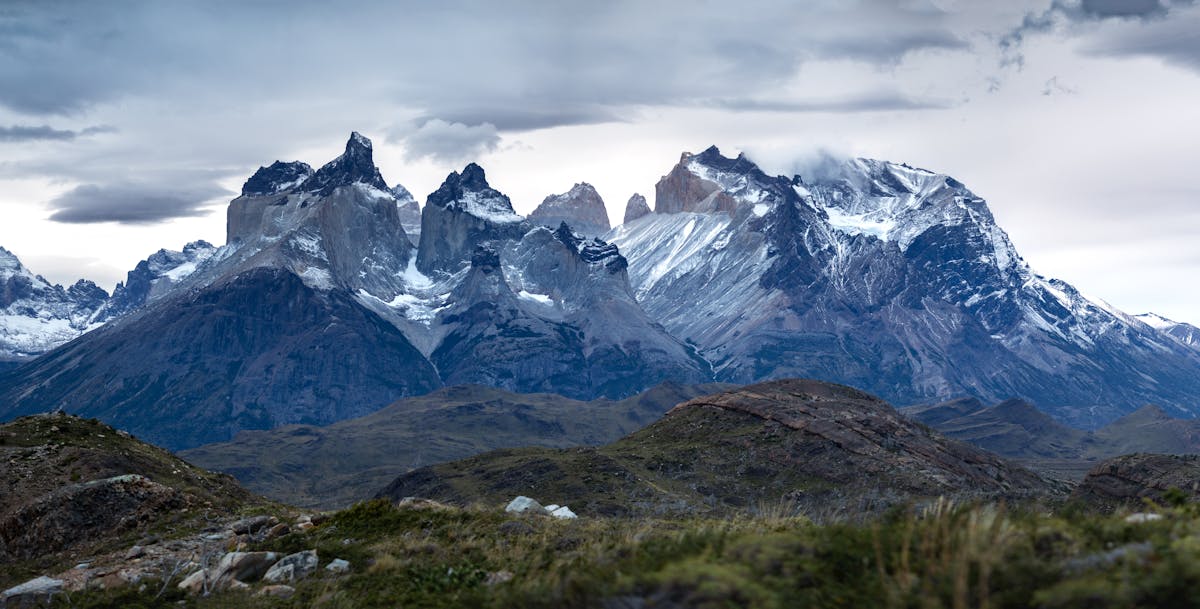
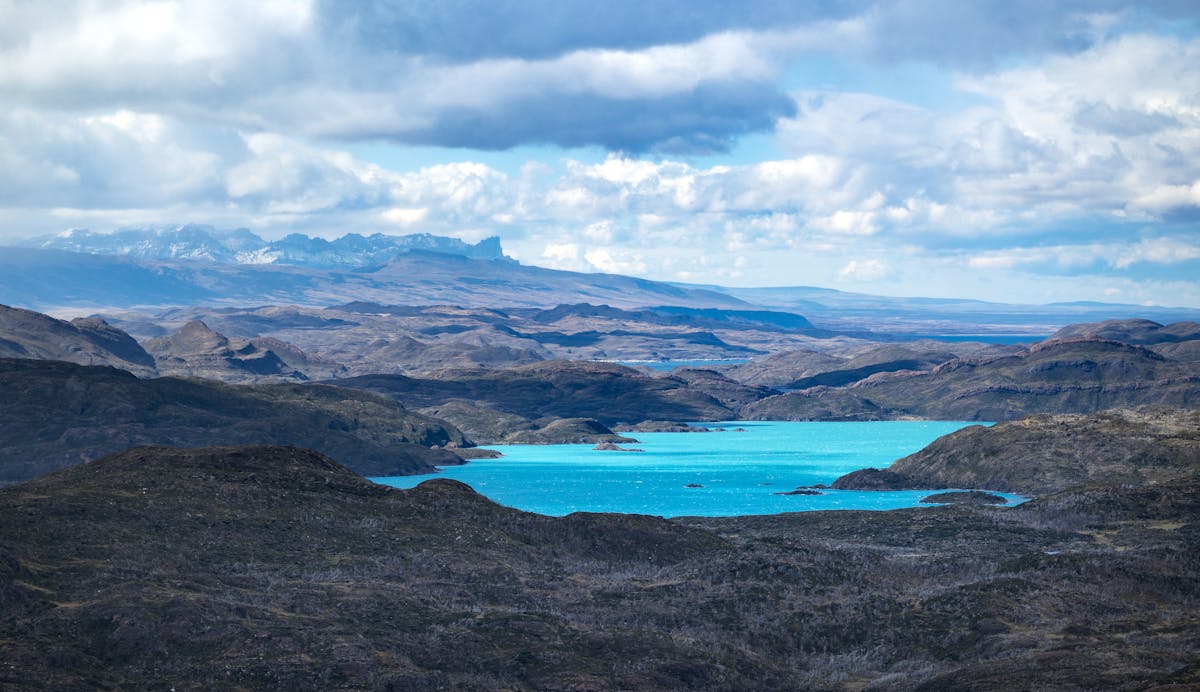
The day starts with a boat ride, and it is a good one. The catamaran across Lago Pehoe runs from Pudeto dock on the northeast shore to Paine Grande lodge on the western side. The crossing takes about thirty minutes, and those thirty minutes might be the most photogenic half hour of your life. The water in Lago Pehoe is this impossible milky turquoise — glacial sediment suspended in the lake gives it a color that looks artificial. The Cuernos del Paine rise directly behind the boat as you cross, and if the weather cooperates, the reflection on the water is absurd.
I caught the first catamaran at 9:30am, which is the one you want. Later crossings work too, but starting early gives you the most time at the glacier and a cushion for weather delays on the return. The catamaran runs two to three times daily in peak season (November through March), less frequently in shoulder months. Check the current schedule at the Pudeto dock or your hostel in Puerto Natales — it changes year to year and the website is not always updated.
The ride costs around 22,000 CLP each way (roughly $24 USD at March 2026 rates). You cannot reserve in advance — it is first come, first served, and the boat fills up. I showed up forty minutes early and there was already a line. During January, people have been turned away. Get there early.
Quick Tip
If you are driving to the park, the Pudeto parking lot fills up fast in summer. The alternative is to take the morning bus from Puerto Natales (leaves around 7:15am) which drops you at the Pudeto dock with time to spare for the first catamaran. See the day hikes guide for all the logistics.
The Trail to Grey Glacier: What to Expect
From Paine Grande lodge, the trail to the Grey Glacier viewpoint is about 11 kilometers one way. That sounds like a lot, and it is a full day, but the trail is not technical. No scrambling, no chains, no sections where you need your hands. It is a well-marked dirt path that climbs and dips through lenga forest, crosses a few streams on wooden bridges, and opens up to lake views that get progressively more dramatic as you go.
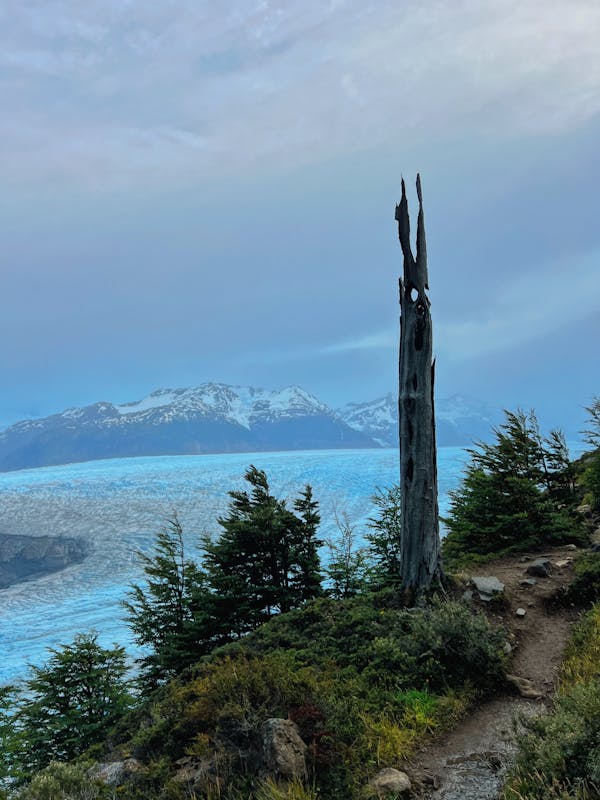
The first hour is the part most people underestimate. The trail leaves Paine Grande and immediately starts rolling through scrubby hillside. It is not steep, exactly, but it is constant up-and-down with no flat respite, and if the wind is blowing (the wind is always blowing), you burn more energy than the gradient suggests. My legs felt this section more than I expected, probably because I was leaning sideways into 50 km/h gusts half the time.
After that initial stretch, the path drops into a lenga forest that shelters you from the wind. This section is genuinely pleasant — dappled light, bird noise, the occasional clearing where you can see the grey-green water of Lago Grey appearing between the trees. The trail is well-maintained with boardwalks over the muddy bits, though after heavy rain those boardwalks can be submerged.
Around the three-hour mark, the forest opens up and Lago Grey spreads out below. This is where you start seeing icebergs. They drift across the lake surface like pieces of a broken puzzle — some the size of a car, others the size of a house. Most are white, but a few catch the light and show that same impossible blue. I spent a good twenty minutes at this first viewpoint before I remembered I was not even at the glacier yet.
Distance and Timing
The numbers: 11 km each way, roughly 22 km round trip from Paine Grande. CONAF (the park service) estimates 3.5 hours each way, which I think is honest for average fitness at a steady pace with brief photo stops. I did it in just under 3 hours going out (I was moving with purpose because the clouds were rolling in) and closer to 4 hours coming back (tired legs, more stops, headwind). Total moving time was about 7 hours, total elapsed time including lunch and glacier-staring was closer to 9.
Elevation gain is moderate — about 350 meters cumulative, spread across several ups and downs rather than one sustained climb. The trail tops out at roughly 200 meters above the lake. Nothing about this hike requires technical skill, but the distance and the wind make it a proper day out. Do not treat it casually.
First Sight of Grey Glacier
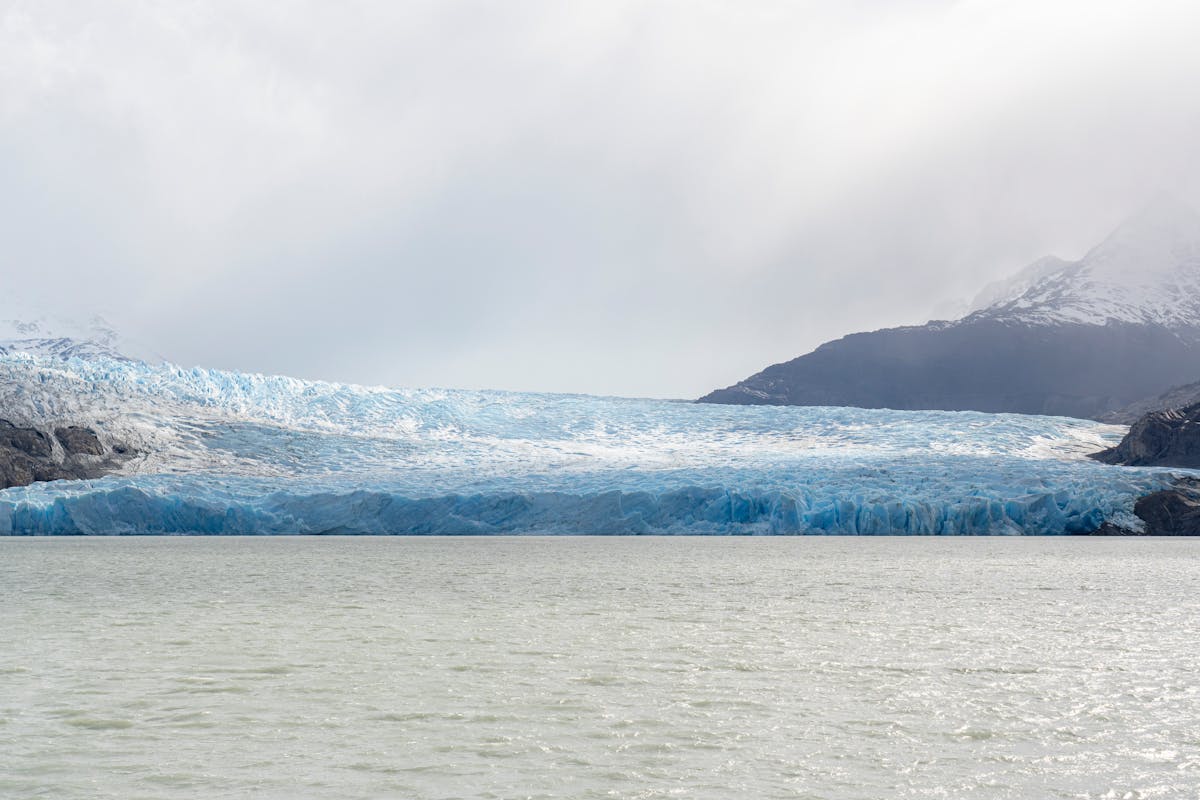
The trail reaches a series of viewpoints above the glacier's terminus between the 9 and 11 km marks. Each one is better than the last, and the temptation to stop at the first overlook and call it done is real — you are tired, the view is already spectacular, and there is a bench. But push on. The final viewpoint puts you close enough to the glacier face to hear it. That cracking, groaning sound of ice under pressure carries across the water, and every few minutes a chunk calves off the face and drops into the lake with a splash you can see but not hear over the wind.
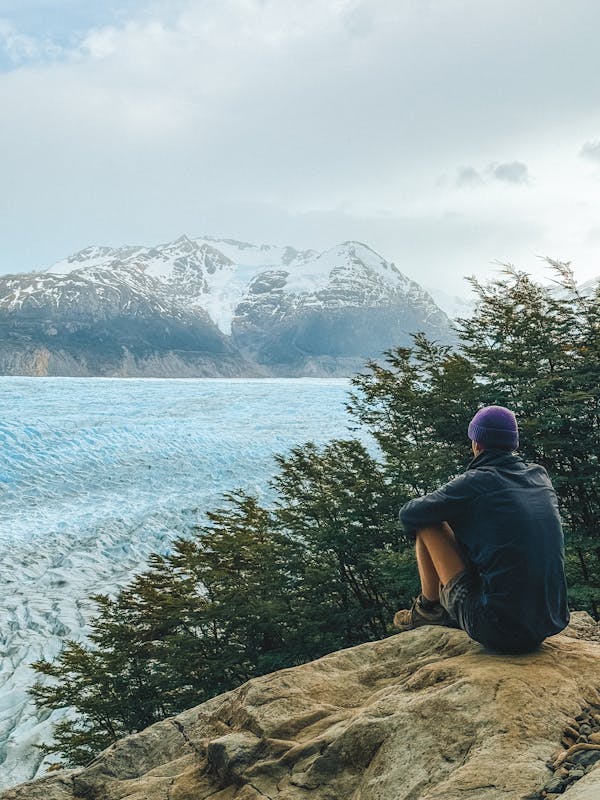
Grey Glacier is massive. It is one of the largest in the Southern Patagonian Ice Field, stretching about 6 kilometers wide at its face and reaching back 28 kilometers into the mountains. Standing at the viewpoint, you cannot see all of it — the ice field disappears behind ridges to the west, and the scale only really registers when you notice a kayak near the face and realize it is the size of a grain of rice.
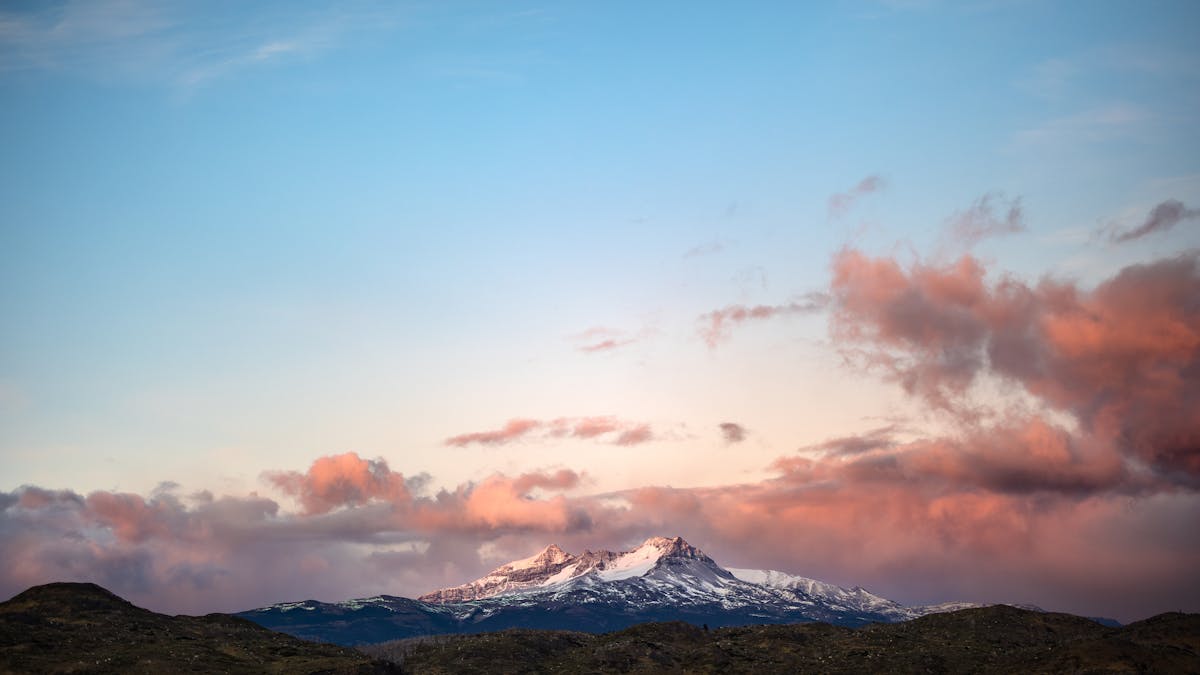
The color changes throughout the day. Morning light makes the ice look almost grey (fitting the name, which actually comes from a 19th-century explorer rather than the color). Midday sun brings out the blues. Late afternoon, if the clouds break, the glacier face takes on a pinkish tint that photographs beautifully. I was there around 1pm and the light was harsh but the blue was at its most intense.
Icebergs in Lago Grey
The icebergs deserve their own section because they caught me off guard. I had fixated on the glacier itself and barely registered that the lake would be full of calved ice. But Lago Grey is studded with icebergs of every size, and many of them have been sculpted by wind and water into shapes that look designed. Arches, spires, flat tabletop pieces that could seat a dinner party. Some are freshly calved and jagged. Others have been floating long enough to develop smooth, curved surfaces that the water has polished.
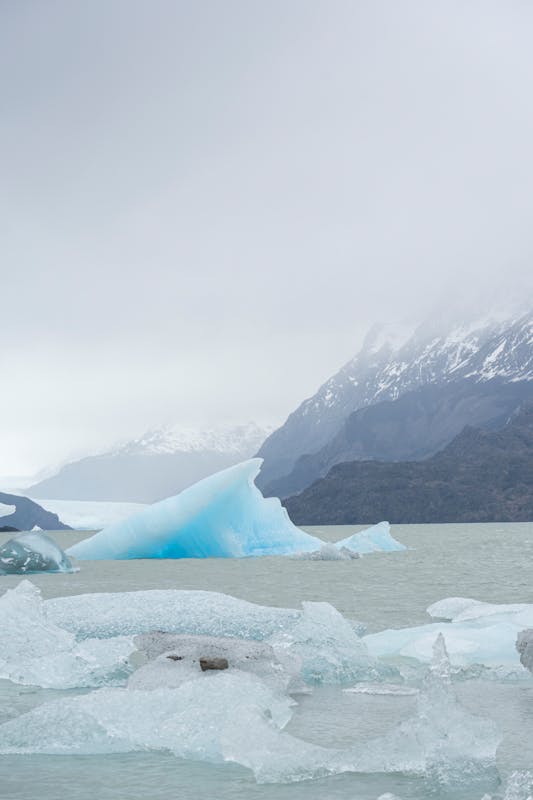
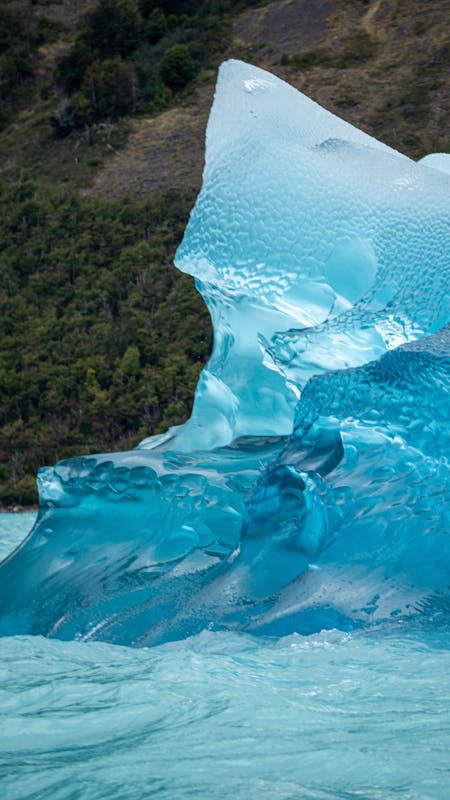
The bluest icebergs are the ones that have recently rolled. When an iceberg flips (which happens as the underwater portion melts unevenly), the freshly exposed surface shows ice that has been under pressure for millennia, and the blue is deeper than anything on the surface. If you see an iceberg with an almost neon blue band, it rolled recently. That is 5,000-year-old ice you are looking at.
The Alternatives: Boat Tour, Kayaking, and Ice Hiking
Walking to the viewpoint is the free option (beyond park entry), but there are three ways to get even closer to Grey Glacier, and all of them are worth knowing about.
The Grey III Boat Tour
A catamaran (confusingly also called a catamaran, different from the Lago Pehoe one) runs from the Hotel Lago Grey dock to the glacier face. The trip takes about 3 hours round trip and gets you within a few hundred meters of the ice wall. They serve pisco with glacier ice on the return, which is exactly as touristy and exactly as fun as it sounds. The boat runs daily in season, costs around 95,000 CLP ($105 USD), and books out in advance during peak weeks.
This is a good option if you want the glacier without the 22 km walk, or if you have limited mobility. The dock is accessible by vehicle from the park road — you do not need to take the Pehoe catamaran or hike from Paine Grande.
Kayaking Among the Icebergs
Several operators run kayaking trips on Lago Grey that put you at water level among the icebergs. This is the option I keep hearing people rave about and the one I have not done yet (next trip, I keep telling myself). Guided trips last 3-4 hours and cost around 130,000-160,000 CLP ($145-180 USD). You paddle through the icebergs, get close to the glacier face, and experience the scale in a way that the viewpoint and even the boat cannot match. You need basic kayaking ability — the lake is cold and the conditions can change fast.
Ice Hiking on the Glacier
Yes, you can walk on Grey Glacier itself. Guided ice hikes run from the western shore, where you strap on crampons and walk across the surface of the glacier for 3-4 hours. You see crevasses, moulins (shafts where meltwater pours into the glacier), and ice formations that are invisible from the viewpoint. Expect to pay 180,000-220,000 CLP ($200-245 USD) for a guided trip including equipment. This is the premium experience, and from what other hikers told me at Paine Grande that evening, it is worth every peso.
Day Trip vs. W Trek: How This Hike Fits
The Grey Glacier trail is the westernmost section of the W Trek, which means you have two ways to approach it: as a standalone day hike from Paine Grande, or as part of the multi-day trek.
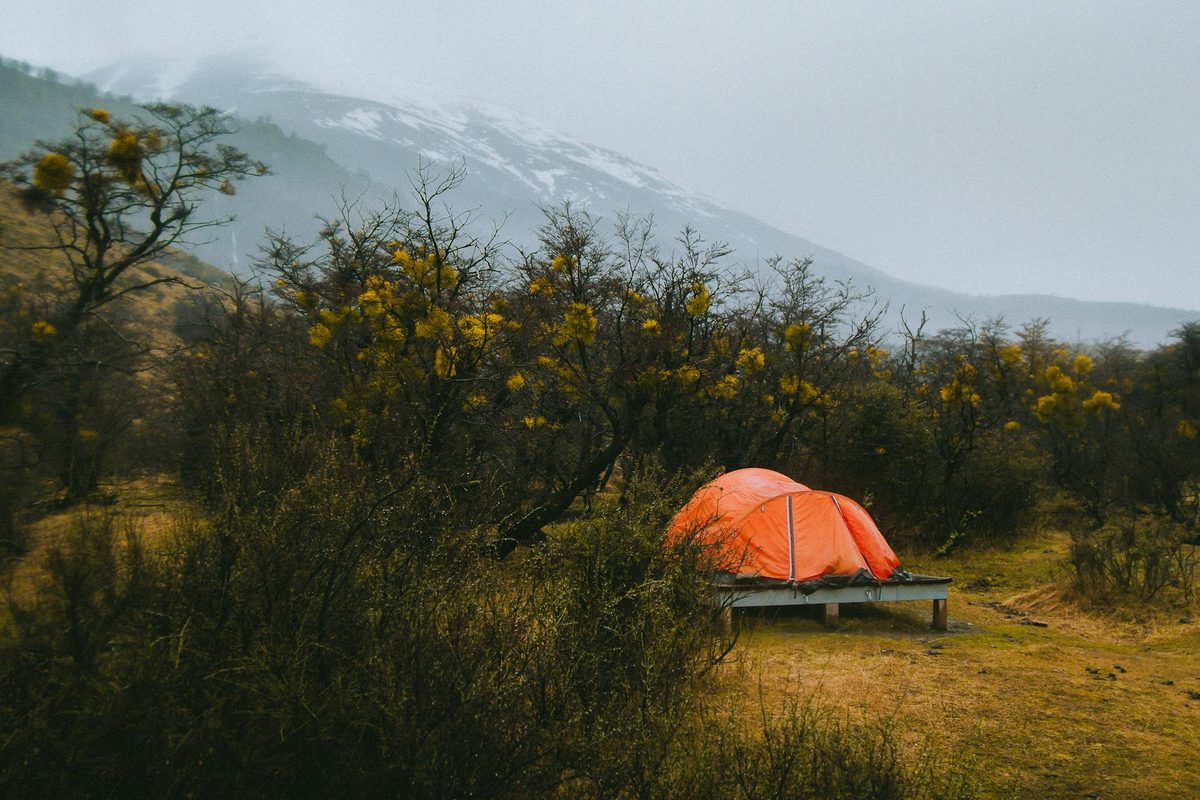
If you are doing the full W Trek, the Grey Glacier section is typically day four or five (depending on direction). You hike from Paine Grande to the glacier viewpoint and back, sleeping at Paine Grande or pushing on to Refugio Grey if you want to split it. Most W Trekkers do the out-and-back from Paine Grande as a day hike within the larger trek. Check the camping guide for details on booking sites along the W.
As a standalone day trip, it is totally doable from Puerto Natales. The schedule is tight but works: early bus to the park, catamaran across Pehoe, hike to the glacier and back, catamaran return, bus back to town. You will be moving all day with limited buffer for delays. On my trip I stayed at Paine Grande the night before, which let me start the hike at dawn and take my time. That is the version I would recommend if you can swing it.
Weather Reality and What to Bring
I need to be honest about the weather because it nearly ruined my day. I started the hike under blue sky and was in a t-shirt by the second hour. By hour three, a cloud bank rolled in from the ice field and the temperature dropped hard. Rain started, then sleet. I put on every layer I had and was still cold at the viewpoint. By the time I turned around, the sun was back. This is not unusual. This is the default.
The Grey Glacier trail is more exposed to weather than the Base Torres or French Valley hikes because it faces west, directly into the prevailing winds from the Southern Patagonian Ice Field. The glacier itself generates its own microclimate — cold air rolling off the ice can drop the temperature several degrees compared to Paine Grande, even on a calm day.
What to Bring
Waterproof shell jacket and pants (non-negotiable). Warm mid-layer (fleece or down). Merino base layer. Hat and gloves — yes, even in January. Sun protection for the exposed sections. At least 2 liters of water. Lunch and snacks — there is nowhere to buy food between Paine Grande and the glacier. Trekking poles help on the return when your legs are tired. Cash for the catamaran. See the full Patagonia packing list.
Costs Breakdown
| Torres del Paine park entry (foreigners) | 35,000 CLP (~$39 USD) |
| Catamaran Lago Pehoe (round trip) | 44,000 CLP (~$48 USD) |
| Bus Puerto Natales to Pudeto (round trip) | 30,000 CLP (~$33 USD) |
| Grey III boat tour (optional) | 95,000 CLP (~$105 USD) |
| Kayaking trip (optional) | 130,000-160,000 CLP (~$145-180 USD) |
| Ice hike on glacier (optional) | 180,000-220,000 CLP (~$200-245 USD) |
| Night at Paine Grande refugio (recommended) | 65,000 CLP (~$72 USD) |
| Camping at Paine Grande | 8,000 CLP (~$9 USD) |
The hike itself is free once you are in the park. The real costs are transport and accommodation. Budget around 110,000-150,000 CLP ($120-165 USD) for a day trip from Puerto Natales including bus, catamaran, and park entry. Add the refugio if you stay overnight. For more on managing costs in Chile, check the trip planning section.
Grey Glacier is one of those places that delivers more than the photos promise. The photos show you a wall of ice. The trail gives you the wind in your face, the cracking sound of calving ice, the shock of blue that no screen reproduces faithfully, and the strange humbling feeling of standing in front of something that has been here for thousands of years and will not be here forever. Walk to it. It is worth every step of those 22 kilometers.